Global Corporate CMS
Iran Fava Gostaresh · IKCO Group
- React 19
- Vite
- Zustand
- React Hook Form
- CKEditor 5
- Highcharts
- SCSS Modules
- Docker
- Azure DevOps
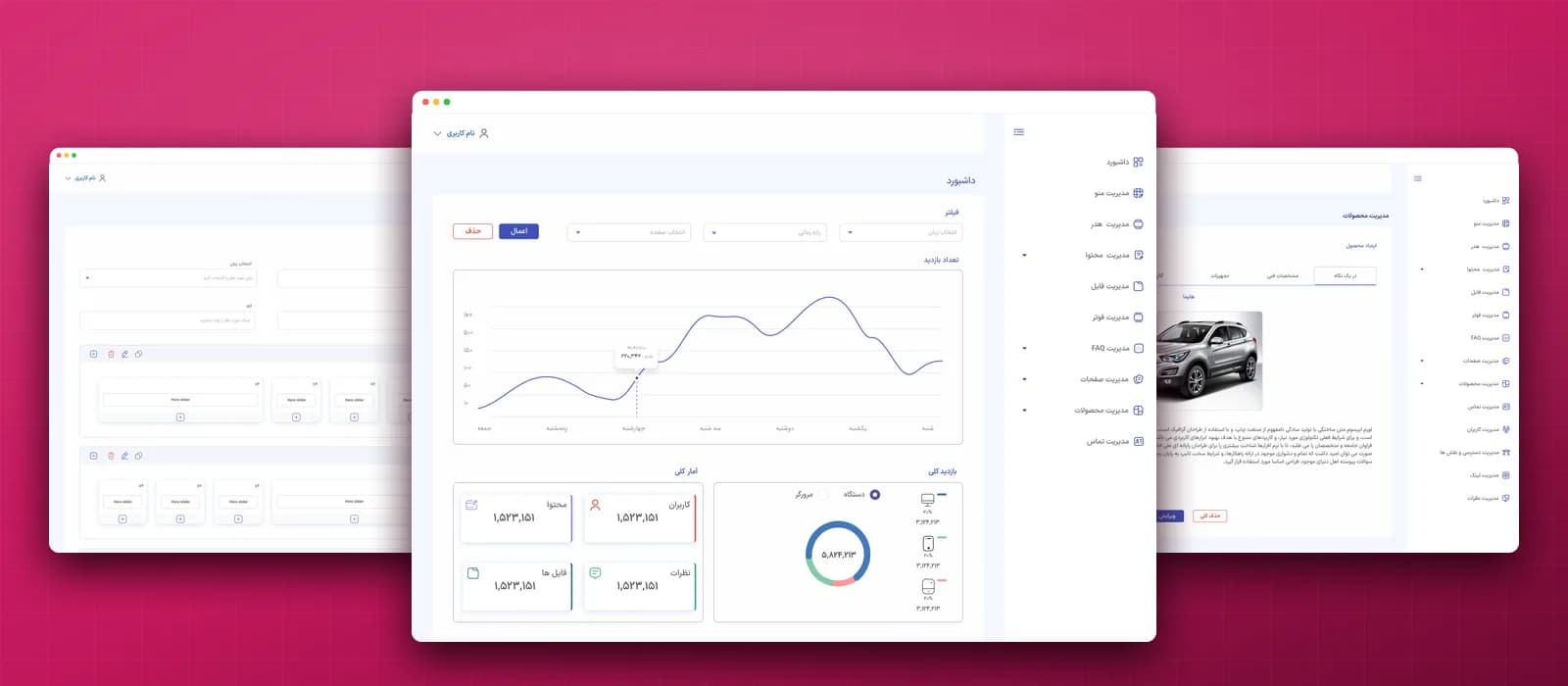
The back office of ikcoglobal.com, Iran Khodro’s global website, and of the IKCO Group portal, deployed as two separate instances of the same build; ikco.ir, still on its older design, is to move onto it later. It is thirteen modules: a dashboard, menu, header and footer management, a file manager, content with categories and tags, FAQs, a page builder, products, contact pages, site members, a URL shortener and comment moderation. Every record - a page, a menu, a footer, a product, a question - is authored per language, so the Persian and English sites are run from the same place without one being a translation layer over the other.
The challenge
The admin panel behind ikcoglobal.com, Iran Khodro’s global website, and the group portal: a section-based page builder with 23 component types, product, content and menu management, comment moderation and a URL shortener - thirteen modules that let non-technical teams run the sites without a deployment.
The company’s RFP asked for two things that pull against each other. Editors were to build pages, products and menus without an engineer - and the result still had to look like one company across a brand family of Iran Khodro, IKD, Peugeot, Haima, Luna, Bestune and Aeolus. A free-form editor solves the first and fails the second within a quarter; a locked template solves the second and sends every new landing page back to the development queue. On top of that, the product pages carry real engineering data - specifications and equipment per trim, interior, exterior and 360° imagery, comparisons, catalogues - that has to stay consistent across dozens of vehicles and two languages.
What I did
- Started the project - React on Vite, Zustand for state, the routing and the layout every module sits in - and built the two pickers the page builder turns on: the section-layout picker and the component catalogue.
- We model a page as a stack of sections; each section takes one of the preset column layouts served by the backend - halves, thirds, quarters, fifths, sixths and their asymmetric and offset mixes - and every column holds components. Editors get real layout control, but the grid underneath stays the site’s own.
- Gave every component type its own settings form and its own store, so the builder itself only places, reorders, clones, hides and deletes; adding a type means adding one self-contained module and one catalogue entry. I built about a dozen of the 23 - gallery, history, recent posts, banner, button, tabs, services, download file, continuous slider, heading and text block among them.
- Gave sections and components the same controls everywhere - collapse, edit, clone, show or hide, delete, and drag to reorder - so building a page is the same gesture at every level, and a finished section is cloned instead of rebuilt.
- Worked on the product side: the product list and the product editor, split into the tabs the public product page shows - overview, technical specifications, equipment, gallery with exterior, interior and 360° sets, comparison and catalogue. Specifications and equipment come from a shared attribute library, so one attribute edited or retired changes every product that uses it.
- Built much of the menu builder: menus per language, nested up to three levels for mega menus, items reordered by drag and drop and switched on or off without being deleted. Only one menu is live per language, and the last live one cannot be removed, so the site never loses its navigation.
- Built the file manager - images, video, documents and audio in their own tabs, filtered by upload date and size - which every “choose from gallery” field in the panel opens as its picker, so all modules point at one asset store.
- Made every list screen the same table - per-column search, multi-select filters, a language filter, an inline active toggle, the same row actions and pagination - so learning one module is learning them all.
Key features
- 13 modules: dashboard, menus, header, footer, files, content, FAQ, pages, products, contact, members, links and comments.
- Section-based page builder with preset column layouts and 23 component types - hero, simple and continuous sliders, product portfolio, gallery, tabs, grid view, FAQ, iframe, text block and more.
- Product catalogue built on a shared attribute library: specifications and equipment, exterior, interior and 360° media, comparison and catalogues.
- Multilingual by design: pages, menus, headers, footers, FAQs, products and contact pages are each authored per language, with one live menu and footer per language.
- Rich-text editing in CKEditor 5 with uploads; drafts, slugs, tags and meta descriptions for articles.
- Shared background editor - solid colour, gradient or image - with a palette of up to ten saved colours kept on the server.
- Comment moderation: per-category settings, a blacklist that holds any comment containing a banned word for review, reports grouped by reason, and member permissions - liking, commenting, reporting - that can be suspended until a set date.
- URL shortener with click counts, and an analytics dashboard of visits by language, period, page, device and browser.
- One build deployed as two tenants: ikcoglobal.com and the IKCO Group portal.
Result
The two sites are run from the panel by content teams rather than by tickets to developers: a landing page is assembled from sections and approved components, a new vehicle is a record in the product library, and a menu change is a drag in the menu builder. Because the components and layouts are the site’s own, what editors build still looks like the same company.
Screens
Select a screen to see it full size.